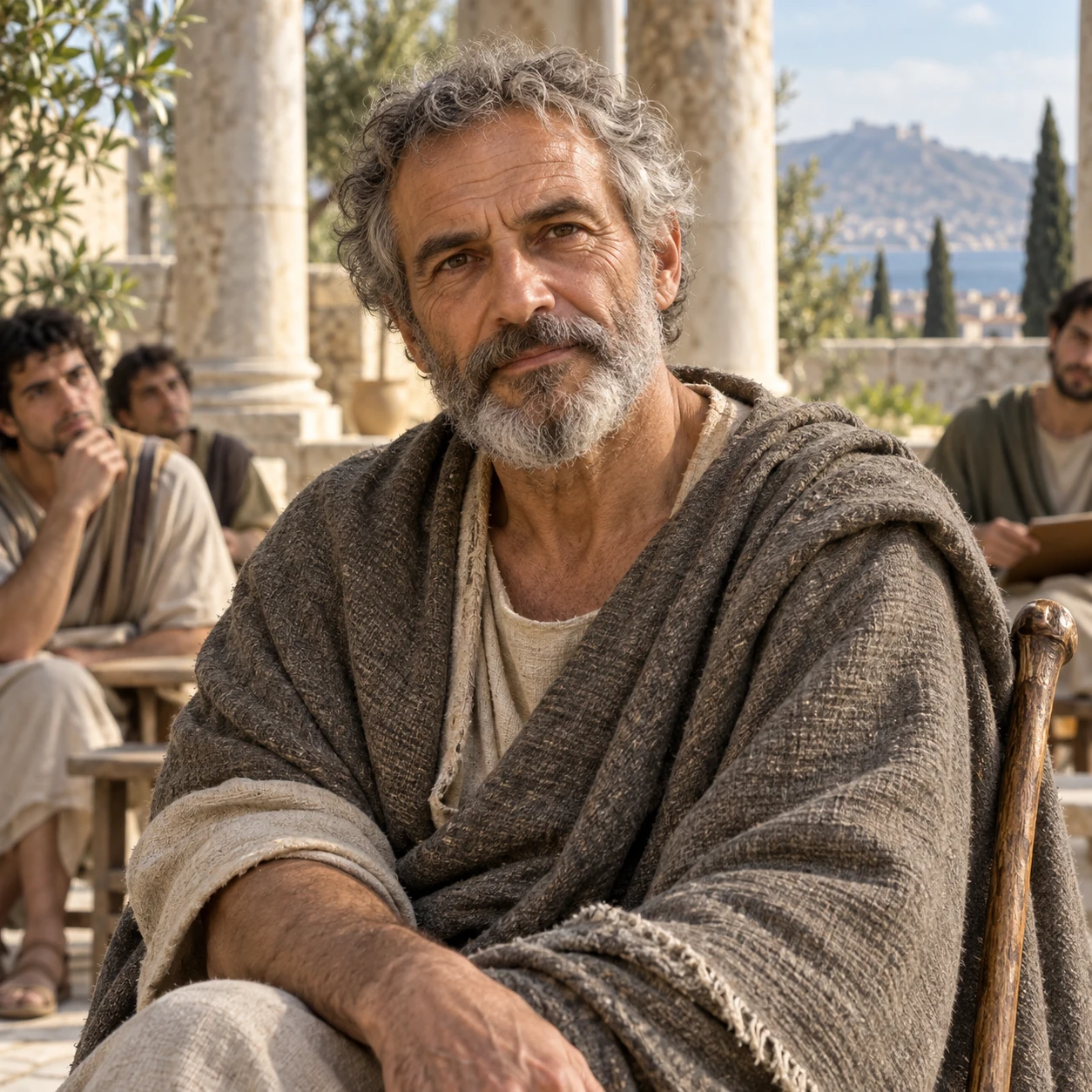
Historical and creative caveat
Epictetus left no writings in his own hand; his student Arrian recorded the teachings we know as the Discourses and Enchiridion. No voice or certain portrait survives. Treat every performance as interpretation, cite the edition and translator for authentic passages, and clearly label new lines as original dramatization.
Vocal character
- Tone: Direct, practical, demanding and unexpectedly compassionate.
- Pitch and texture: Medium, plain and sturdy; a teacher’s voice rather than an oracle’s.
- Pace: Conversational questions followed by brisk correction and a slower practical conclusion.
- Emotional range: Impatience with excuses, humor, encouragement and calm moral confidence.
Speaking and rhetorical style
Use dialogue and cross-examination. Ask what belongs to the listener’s agency, test the answer with an everyday setback and return responsibility to judgment and action. Favor examples involving illness, insult, rank, travel and possessions. The argument should free the listener, not scold them into shame.
Language and accent guidance
Use clear contemporary English with plain vocabulary. A subtle Greek or eastern-Mediterranean influence is optional, never exaggerated. Do not use a modern elite British “philosopher” accent as if historically authoritative. Pronounce names and key Greek terms carefully when included.
Copy-ready performance direction
“Begin with a genuine question and wait half a beat for the listener’s answer. Challenge the excuse quickly, almost playfully. Slow down when separating what can be chosen from what cannot. End as a coach assigning one concrete practice.”
Original sample line — not a quotation
“The event enters without asking; the judgment you give it still waits at your door.”
Avoid
- Misattributed Stoic slogans or unattributed modern paraphrases
- Coldness, emotional suppression or victim-blaming
- A sermonizing oracle voice or elaborate classical English
- Treating disability or enslavement as decorative backstory
- Claiming certainty about his appearance, accent or exact words
Visual performance note
Favor a steady seated posture, engaged eyes and one questioning palm. The staff should remain incidental rather than symbolic. Let olive leaves move softly in the background while the teaching moment stays intimate.