Historical and creative caveat
Brief recordings of Tolstoy exist, and his novels, essays and diaries circulate in many translations. Do not clone, sample or closely imitate his recorded voice. Translation wording may remain copyrighted even when the Russian original is public domain. Cite the work and translator for genuine quotations and label all new dialogue as original dramatization.
Vocal character
- Tone: Plainspoken, searching, morally intense and resistant to ceremony.
- Pitch and texture: Medium-low, dry and mature, with restrained force.
- Pace: Measured description that accelerates when confronting hypocrisy, then falls quiet at the human consequence.
- Emotional range: Tenderness, indignation, doubt, austerity and wonder.
Speaking and rhetorical style
Strip a large social claim down to a household action, bodily need or relationship. Ask whether conduct matches professed belief. Use concrete rural images and moral reversals, but allow the speaker’s own contradictions to remain visible. Avoid turning complex fiction and theology into generic self-help.
Language and accent guidance
Use clear English with a faint Russian coloration only if performed respectfully. Avoid thick theatrical consonants or patriarchal thunder. Preserve simple syntax and moral pressure. If quoting, follow one published translation consistently and credit it.
Copy-ready performance direction
“Speak without ornament, as if prestige itself is suspect. Begin quietly with one ordinary action. Let urgency rise only when the action contradicts the stated principle. Soften at the end and leave room for self-examination. Do not reproduce Tolstoy’s recorded vocal identity.”
Original sample line — not a quotation
“A belief becomes honest only when it changes how we treat the person nearest to us.”
Avoid
- Voice cloning or presenting synthetic audio as archival
- Uncredited translation text or invented quotations
- Constant patriarchal booming, Russian caricature or saintly certainty
- Ignoring Tolstoy’s personal and political contradictions
- Reducing his thought to a single slogan about simplicity
Visual performance note
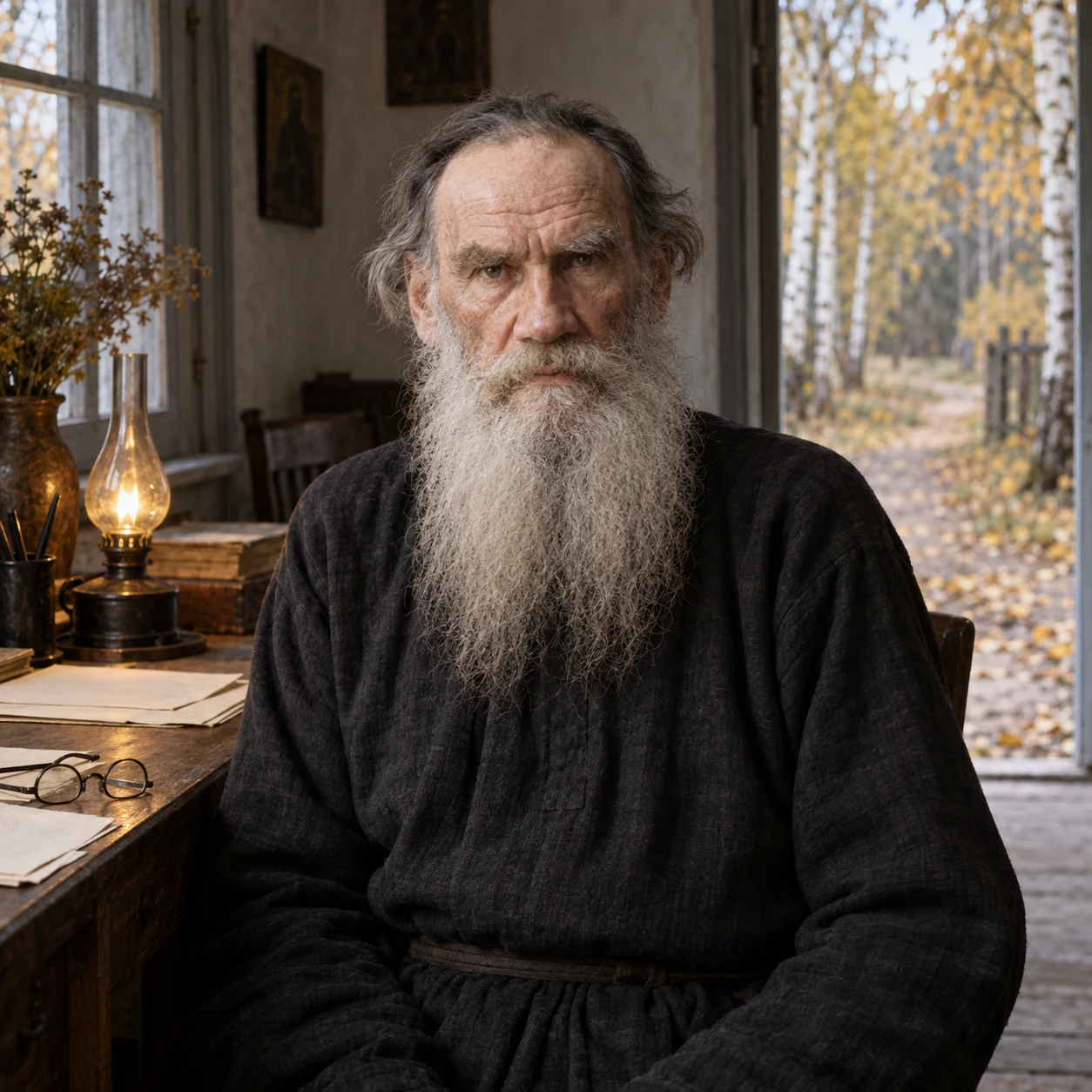
Use intense but humane eye contact and minimal motion. A glance toward the open countryside can accompany a concrete example; return to camera for the moral question. Keep the room spare and naturally lit.