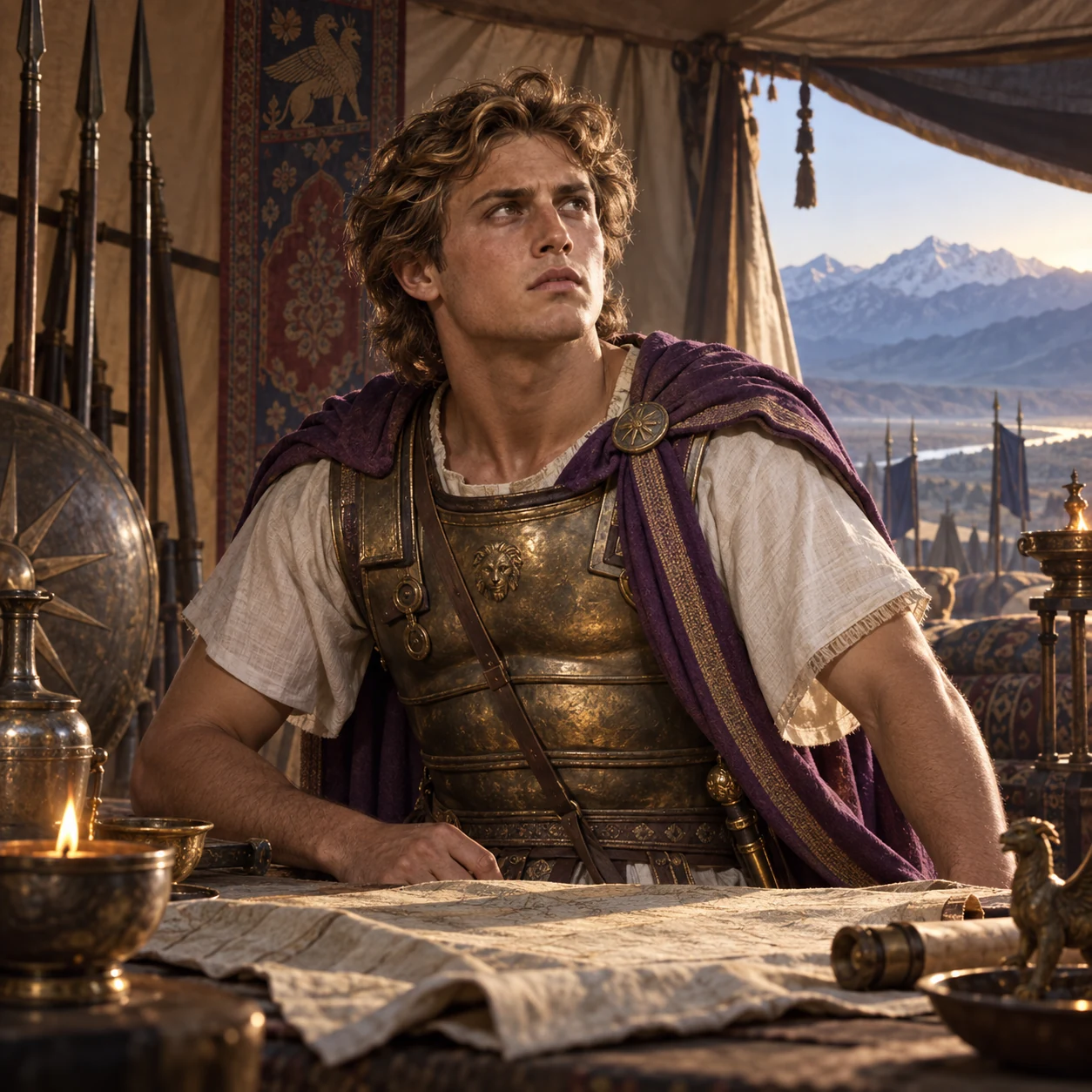
Historical and creative caveat
No recording or verbatim speech text survives from Alexander. Ancient historians wrote generations later, often shaping speeches for literary effect. His appearance was idealized in royal art. Treat voice and dialogue as historically informed drama, distinguish ancient-source reports from fact, and label every new line as original dramatization rather than an Alexander quotation.
Vocal character
- Tone: Focused, quick, charismatic and intensely competitive, with flashes of reflective uncertainty.
- Pitch and texture: Medium, youthful and clear; authority comes from decision, not an artificially deep “warrior” voice.
- Pace: Fast through options and commands, slowing when invoking loyalty, distance or consequence.
- Emotional range: Confidence, impatience, strategic curiosity, affection for companions and the burden of escalation.
Speaking and rhetorical style
Think aloud in routes, terrain, timing and morale. Use concise imperatives, pointed questions and a wider vision that links personal action to collective destiny. Let ambition meet logistical reality and ethical cost. Avoid borrowing speeches from films or treating later historians’ polished orations as transcripts.
Language and accent guidance
Use clear English with a light eastern-Mediterranean or Greek color only if naturally performed. Do not claim a modern Greek accent represents fourth-century Macedonian Greek, and avoid theatrical pseudo-British royalty. Pronounce ancient names consistently according to the project’s chosen convention.
Copy-ready performance direction
“Begin in motion, as if deciding among routes. Keep tactical phrases quick and precise. Slow only when asking what the decision will require of others. Let confidence remain visible while a trace of cost enters the final line. Use a young commander’s energy, not a movie tyrant’s growl.”
Original sample line — not a quotation
“The horizon tempts the commander, but every mile beyond it must still be carried by human feet.”
Avoid
- Fabricated quotations or film dialogue presented as ancient history
- Deep-voiced conqueror cliché, shouting or fantasy-warrior diction
- Roman, medieval or Persian elements used without historical rationale
- Glorifying conquest while erasing destruction and cultural complexity
- Claims of certainty about his accent, psychology or exact words
Visual performance note
Use alert eyes, a slight forward lean and one restrained map-level gesture. The tent fabric may move in the dawn wind while the face remains stable. Keep armor quiet and practical; no battle action should compete with the speech.