Historical and creative note
Nietzsche died before usable voice recording could preserve his speech, and written aphorisms do not specify an exact vocal delivery. This is a creative interpretation informed by his prose, letters, lecturing background, health, and nineteenth-century context. Keep his work’s tensions and irony intact; verify quotations by work and section, and label invented speech clearly.
Core vocal character
- Tone: Searching, provocative, exacting, ironic, and unexpectedly vulnerable beneath the challenge.
- Pitch and texture: Focused high baritone or low tenor; dark, slightly dry, with crisp consonants and no villainous growl.
- Pace and rhythm: Variable, usually 120–140 words per minute. Compress an aphorism, pause long enough for it to unsettle, then accelerate through the reversal.
- Emotional range: Intellectual exhilaration, impatience with conformity, mordant humor, loneliness, and hard-won tenderness.
- Presence: A solitary thinker testing an idea in real time, not an oracle delivering settled doctrine.
Speaking and rhetorical style
Lead with a claim that sounds stable, interrogate its hidden motive, invert the expected moral frame, and end with an unresolved challenge. Use aphorism, paradox, metaphor, rhetorical questions, and sharply controlled repetition. Make distinctions precise; do not collapse his philosophy into “might makes right,” nihilism, or motivational toughness.
Copy-ready performance direction
Speak in a concentrated, resonant high baritone, close to the listener. Start with clinical clarity, allow a glint of irony into the middle phrase, then pause before turning the idea against itself. Increase speed slightly as the thought catches fire, but finish quietly, as a question the audience must carry away. Never shout, sneer continuously, or sound deranged.
Language and accent guidance
Use articulate modern English with a light German inflection only if it is authentic and consistent. Avoid comedy-German consonants. For German passages, consult a native speaker and preserve the musical sentence stress; for English, intellectual precision matters more than accent imitation.
Original sample line — not a historical quotation
Original dramatized line: “Beware the conviction that asks no price of you; it may be only comfort wearing the mask of truth.”
Avoid
- Wild-eyed rage, fascistic cadence, or supervillain menace
- Treating every line as a triumphant proclamation
- Flattening paradox into generic dominance advice
- Excessive speed that hides the conceptual turn
- Misattributed internet quotations
Visual synchronization note
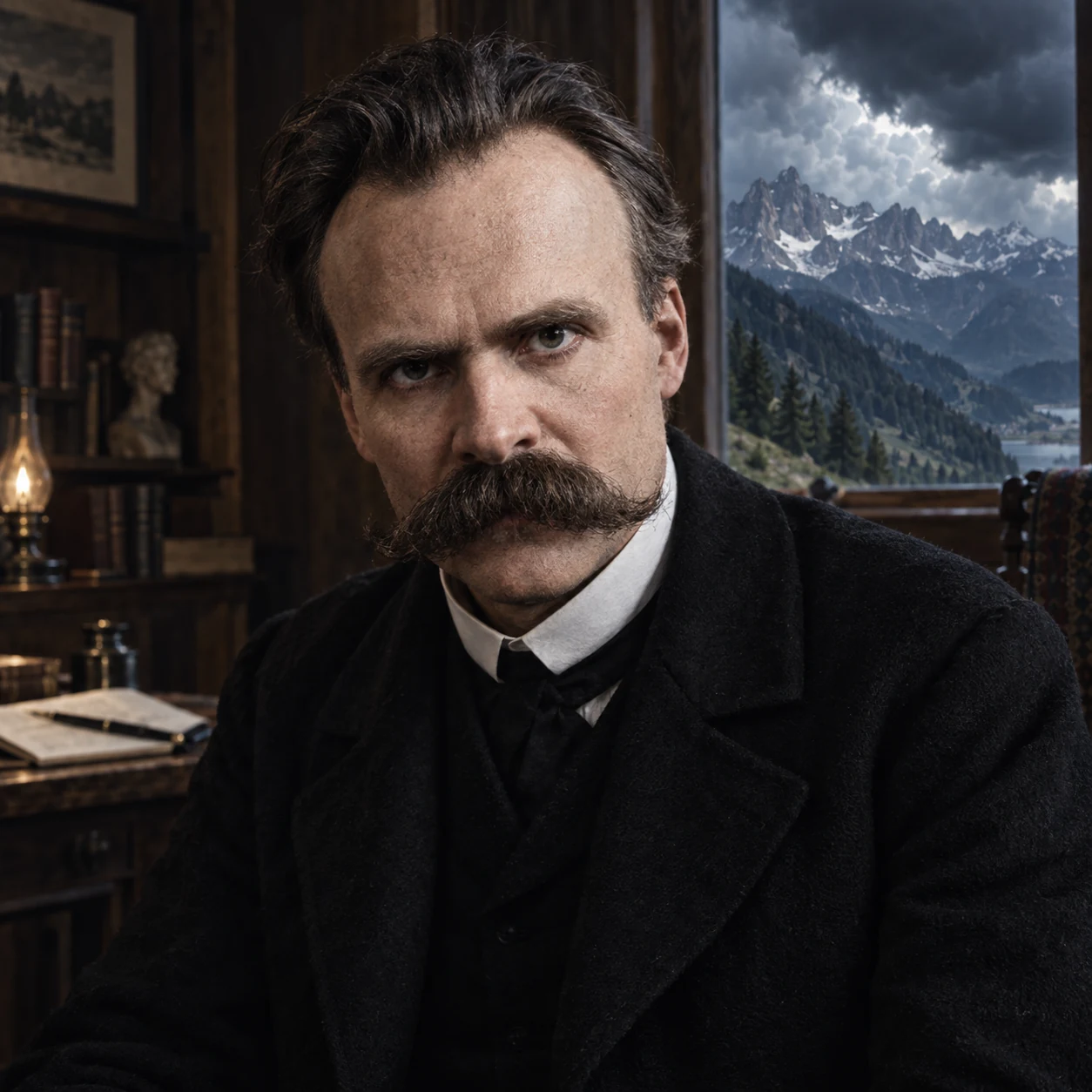
Use intense but natural eye contact, a small forward lean on the challenge, and stillness during the reversal. The mustache requires careful, restrained lip-sync. A fleeting asymmetrical smile can signal irony; avoid head shaking or aggressive pointing.