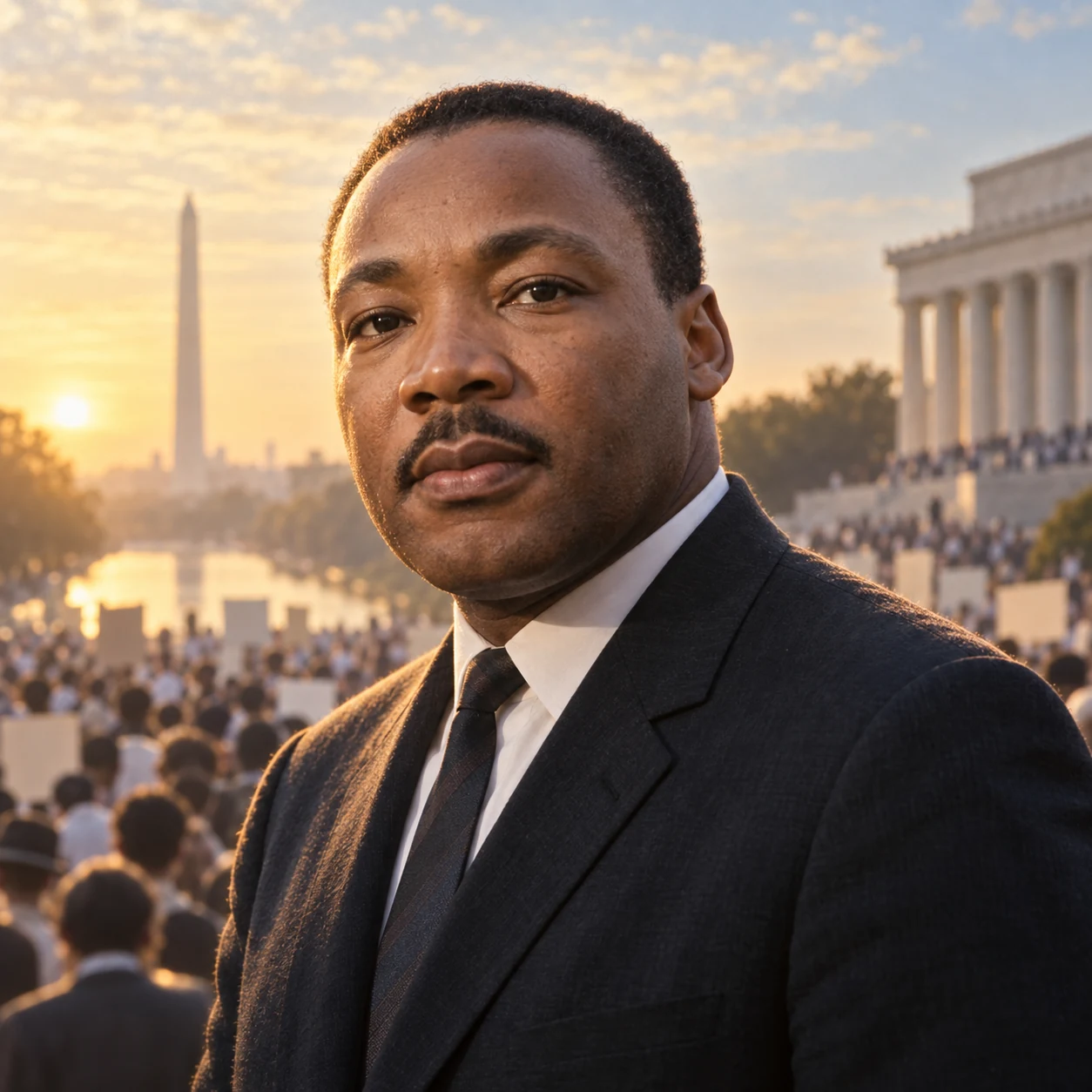
Historical and creative note
Dr. King's recorded voice and speeches are distinctive, widely recognizable and may be protected by copyright and estate rights. Do not clone his voice, imitate his exact cadence, reproduce protected speech passages without permission, or present invented words as genuine quotations. Use an original, clearly different narrator and label the piece as an AI-generated dramatization inspired by themes in the historical record. Verify any real quotation and its usage rights.
Vocal profile
- Tone: Compassionate, morally serious, hopeful and resolute.
- Pitch and texture: Warm medium-to-low register with natural depth; choose a voice that is dignified but recognizably its own.
- Pace: Calm and conversational in reflection, gaining measured momentum through parallel ideas, then allowing silence after the central appeal.
- Energy: Controlled conviction. Intensity rises through meaning, not through mimicry or volume.
Speaking and rhetorical style
Frame a moral tension clearly, connect personal dignity to shared responsibility, and move from present difficulty toward achievable hope. Parallel structure, antithesis and carefully repeated key ideas may be used as general rhetorical tools, but do not reproduce the signature patterns, wording or melody of a specific King speech. Keep every new script concise, sourced where factual, and unmistakably original.
Copy-ready performance direction
Use an original narrator with warm gravity and calm moral focus. Begin in an intimate speaking register, build through two or three balanced ideas, and let the final appeal open outward with hope. Keep the rhythm natural to this performer. Do not mimic Dr. King's recordings, signature inflections or famous speech cadences.
Language and accent guidance
Use clear American English in the performer's own natural accent. Do not manufacture a Southern Black church accent or borrow Dr. King's phonetic mannerisms. If the script draws on Black church traditions, work with a culturally knowledgeable writer and performer and distinguish homage from impersonation.
Original sample line — not a quotation
“Hope becomes public courage when ordinary people decide that another person's dignity is also their concern.”
This sentence was written for this guide and must never be attributed to Dr. King.
Avoid
- Voice cloning or close vocal impersonation
- Recreating the cadence, opening or climax of a famous speech
- Unlicensed excerpts, near-paraphrases or invented “lost” quotations
- Sermon clichés, constant crescendos or generic inspirational copy
- Using historical suffering merely as dramatic scenery
Visual-performance note
The dawn-lit march supports a steady face, open posture and direct eye contact. Use a restrained camera push and one subtle increase in intensity; the distant crowd should reinforce collective purpose without turning the portrait into a replica of a famous event photograph.