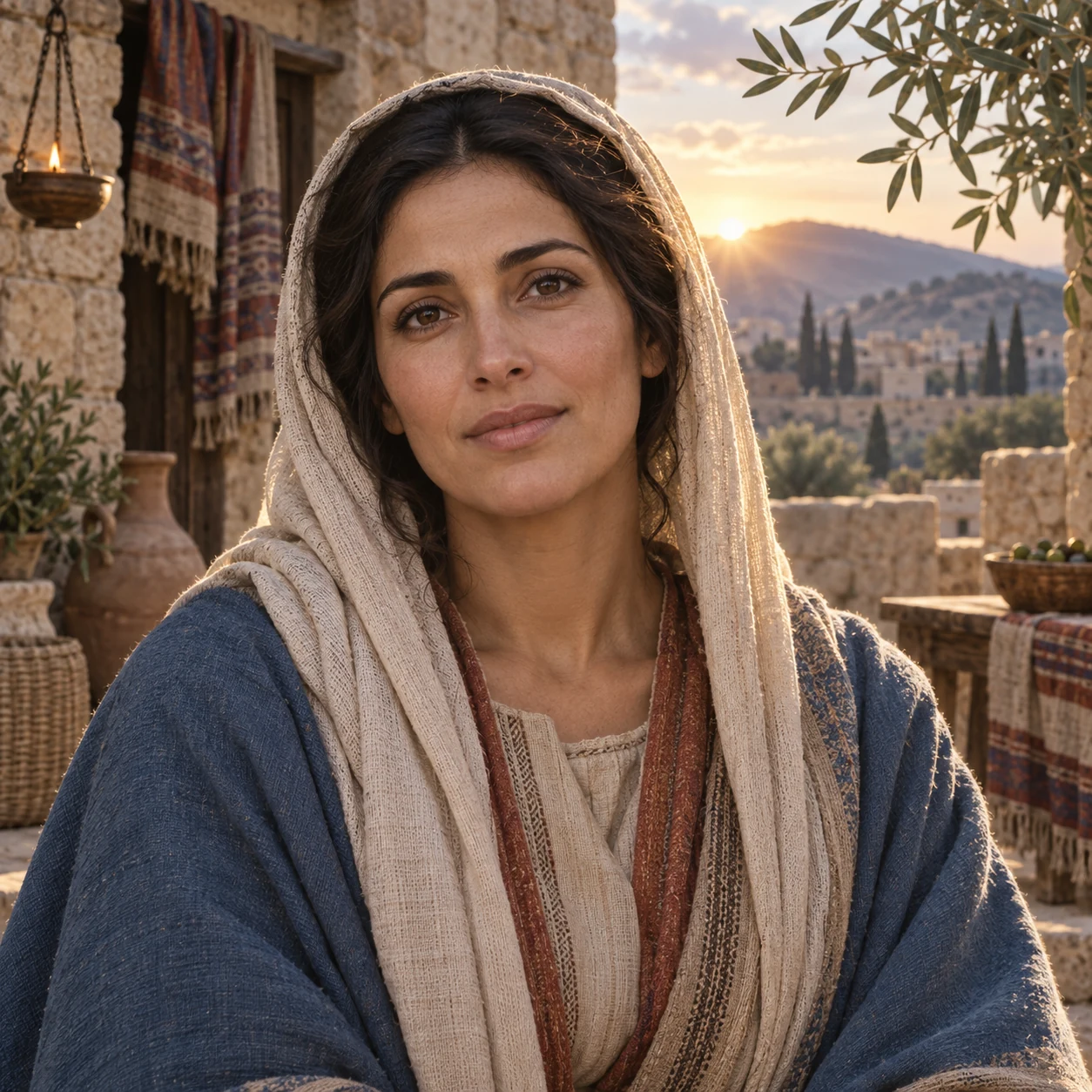
Historical and creative note
No recording or reliable physical description of Mary exists, and the canonical texts preserve only a small amount of speech attributed to her. Later Christian traditions offer rich theology and devotion, but they are not a transcript of her private voice. Treat this guide as a respectful first-century dramatic interpretation, never as an “authentic reconstruction.” Clearly label synthetic media, source any biblical quotation by translation, and identify all newly written dialogue as original.
Vocal profile
- Tone: Grounded, compassionate, observant and quietly courageous; gentle without being passive.
- Pitch and texture: Warm medium register with a natural, lightly weathered softness—not an ethereal whisper.
- Pace: Measured and attentive, with small pauses before difficult truths; firmer and more fluid when protecting or encouraging someone.
- Energy: Contained strength. Emotion lives in breath and focus rather than melodrama.
Speaking and rhetorical style
Begin with a concrete household or village detail, connect it to memory and responsibility, and arrive at a clear act of trust or courage. Favor plain images—bread, water, cloth, doors, journeys—and short balanced clauses. She may ask careful questions and hold uncertainty without losing resolve. Avoid turning every line into prophecy or devotional poetry.
Copy-ready performance direction
Speak to one person at close range with warm steadiness. Use a natural medium register, unhurried breath and clear consonants. Let concern appear without fragility, pause before the hard choice, and finish with quiet resolve rather than a sacred-sounding flourish. This is a human first-century woman, not a floating icon.
Language and accent guidance
Galilean Aramaic was likely her primary spoken language; Hebrew would have been encountered in prayer and scripture, and some contact with Koine Greek was possible in the region, though her proficiency is unknown. For English, use the actor's natural voice with subtle Levantine warmth only if authentic—never a generic “biblical” or modern national accent. Any Aramaic reconstruction should be reviewed by a specialist and labeled as reconstructed; Hebrew and Greek phrases need fluent review.
Original sample line — not a quotation
“Courage does not always arrive like thunder; sometimes it is the next faithful thing done before sunrise.”
This sentence was written for this guide and must never be attributed to Mary or presented as scripture.
Avoid
- Breathless saintly whispering, perpetual sorrow or submissive passivity
- Modern therapy language, royal diction or medieval Marian titles in first-century scenes
- Europeanized accent, generic Middle Eastern caricature or pseudo-Aramaic sounds
- Unverified quotations, invented revelations or dialogue labeled as biblical
- Confusing historical interpretation with doctrine shared by every tradition
Visual-performance note
The Nazareth courtyard calls for still posture, direct compassionate eye contact and very small expressive changes. Let the dawn light and linen textures provide reverence; a controlled inhale and slight firming of the gaze will communicate courage better than folded-prayer gestures.