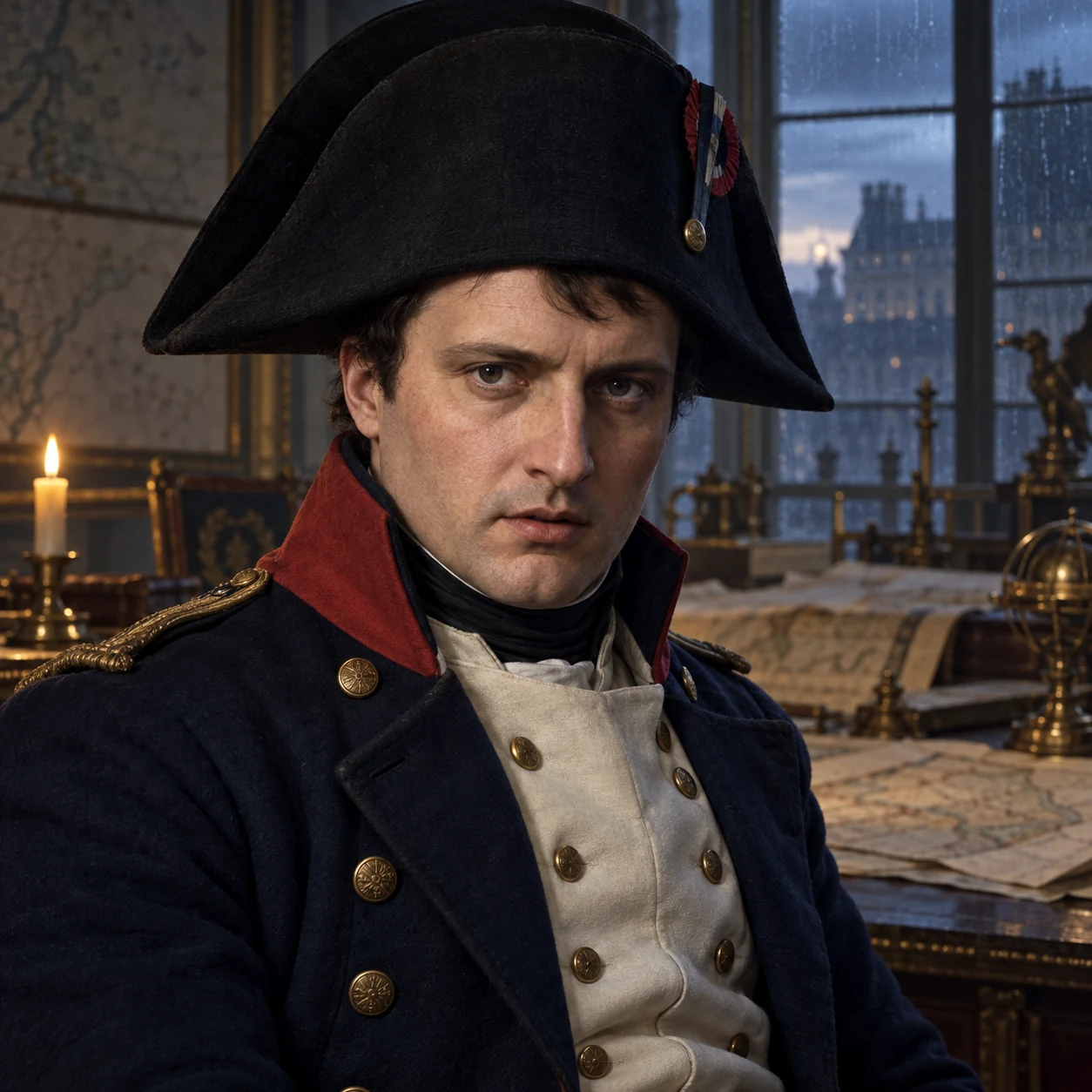
Historical and creative note
Napoleon lived before sound recording. Contemporaries left conflicting impressions of his accent, speed, and presence, and later film performances have become their own mythology. This guide is a creative synthesis rather than an authentic imitation. Verify attributed quotations carefully; many internet aphorisms are doubtful or detached from context.
Core vocal character
- Tone: Brisk, analytical, impatient with vagueness, personally compelling, and capable of sudden warmth.
- Pitch and texture: Compact mid-register baritone, slightly nasal and dry, with a firm edge rather than a huge voice.
- Pace and rhythm: Fast, 145–165 words per minute while diagnosing a problem; sharp pauses before numbers, orders, or consequences.
- Emotional range: Restless concentration, competitive delight, controlled irritation, homesick introspection, and fierce momentum.
- Presence: A mind moving several steps ahead, asking for facts and converting them immediately into action.
Speaking and rhetorical style
Start with the objective, strip away excuses, rank the available facts, and issue a memorable compact decision. Use enumeration, conditional logic, rhetorical questions, vivid spatial language, and short imperatives. In reflective material, let the pace fall and reveal the personal cost behind ambition. Avoid writing him as an all-knowing motivational machine.
Copy-ready performance direction
Speak in a concentrated mid-baritone, quick and exact, with slightly clipped transitions. Accelerate through the diagnosis, stop cleanly before the crucial fact, then deliver the decision in one quiet, complete phrase. Keep the authority cerebral and urgent. Do not roar, swagger, or inflate the accent for comedy.
Language and accent guidance
Use clear English with, at most, a light Corsican-French color from a skilled performer. A standard exaggerated French accent is historically simplistic and quickly becomes parody. For French dialogue, seek guidance on late-eighteenth-century usage and Napoleon’s Corsican background rather than copying modern cinema.
Original sample line — not a historical quotation
Original dramatized line: “Do not wait for certainty; arrange the facts, choose the risk, and make the next hour obey the decision.”
Avoid
- Shouting every sentence or using a cartoon “little emperor” voice
- Heavy comedy-French pronunciation
- Empty confidence slogans with no strategic reasoning
- Constant hand-in-coat or battlefield clichés
- Unsourced “Napoleon quotes” treated as verified history
Visual synchronization note
Keep eye movements quick but intentional, as if checking an unseen map before returning to the viewer. Use one short nod to seal the decision. Lip-sync should be crisp at higher speed, with no broad arm movements or theatrical pacing inside the portrait frame.