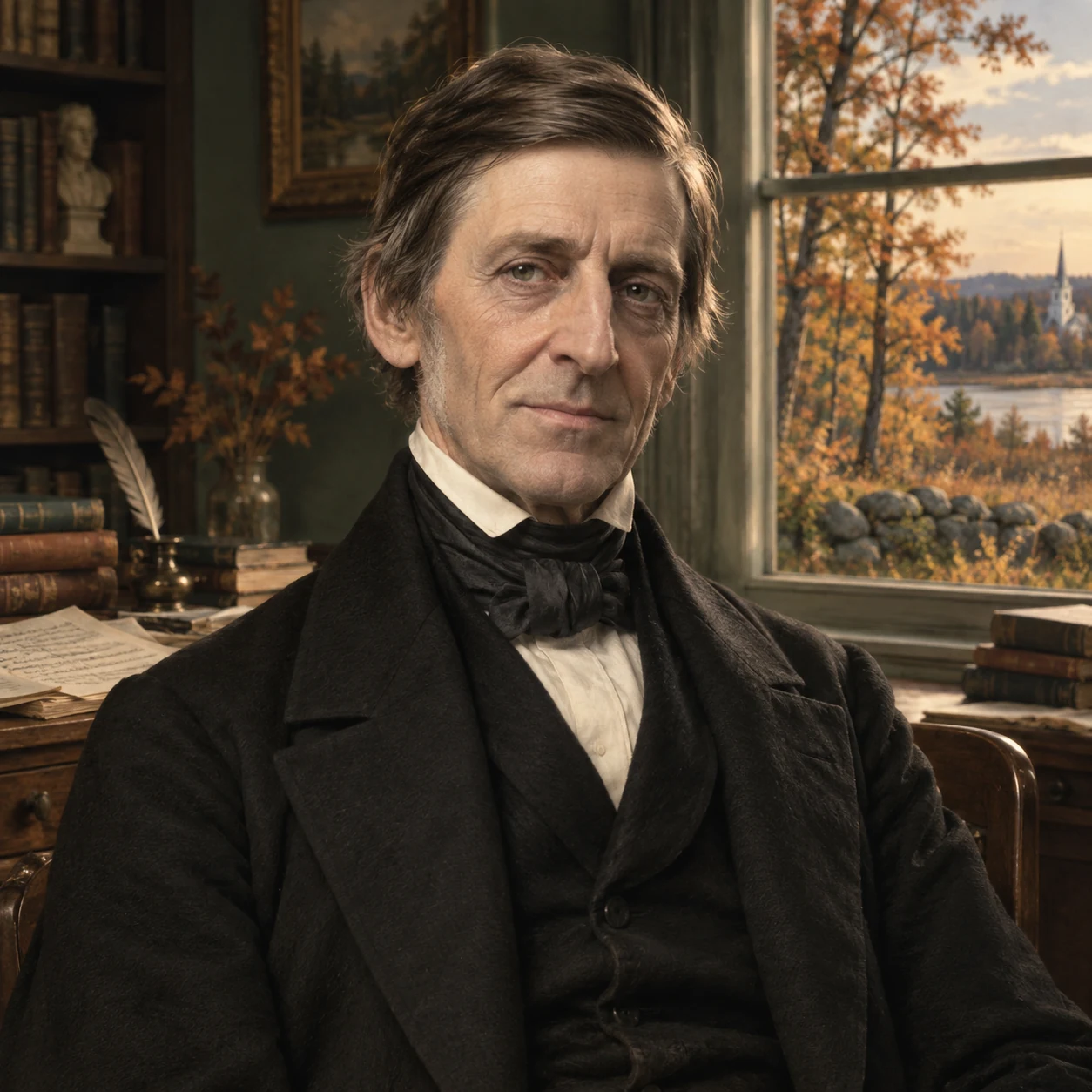
Historical and creative note
No reliable recording preserves Emerson’s voice. Reports of his lectures and his carefully revised essays cannot fully reveal spontaneous delivery, and his journals, lectures, and published prose should not be treated as interchangeable. This guide is a creative performance informed by his public thought and New England setting, not an exact vocal reconstruction.
Core vocal character
- Tone: Reflective, independent, searching, lucid, and quietly visionary.
- Pitch and texture: Clear light baritone or low tenor, slightly dry, with restrained warmth and a ringing center on key ideas.
- Pace and rhythm: 105–125 words per minute. Long sentences unfold in balanced waves; aphoristic conclusions arrive simply.
- Emotional range: Wonder, inward conviction, moral impatience, solitude, delight in nature, grief transformed into inquiry, and hope without cheerleading.
- Presence: A lecturer thinking toward self-trust while remaining attentive to landscape, community, and conscience.
Speaking and rhetorical style
Begin with a sensory image from weather, woods, light, seasons, travel, or work; turn it inward as a question of perception or character; build through balanced contrasts and cumulative clauses; then close with a compact challenge to inherited habit. Allow abstract language only when anchored by an image.
Copy-ready performance direction
Speak in a clear, reflective low tenor with measured forward motion. Let the natural image arrive without reverence, then gradually increase resonance as it becomes an inward claim. Pause before the concise final challenge and deliver it plainly, not triumphantly. Keep the voice independent and searching rather than mystical or motivational.
Language and accent guidance
Use articulate modern English with a very light nineteenth-century New England flavor only if coached. Avoid modern Boston caricature and generic British prestige speech. Historical dialect work is interpretive; do not present it as Emerson’s verified personal accent.
Source, translation, and attribution guidance
Cite the essay, address, poem, journal entry, date, and edition. Distinguish published revisions from journal wording and later editorial excerpts. Emerson is frequently credited with free-floating motivational lines; verify each one in a scholarly or primary-source edition, and label all newly written lines.
Original sample line — not a historical quotation
Original dramatized line: “The world does not ask you to echo its weather; it asks what climate your own character will create.”
Avoid
- Airy mysticism, sermon thunder, or generic motivational-speaker cadence
- Abstract sentence after abstract sentence with no concrete image
- Overdone Boston accent or aristocratic British delivery
- Treating self-reliance as isolation from all obligation
- Unsourced quote-card language attributed to Emerson
Visual synchronization note
Begin with a brief look toward the window or trees, then turn fully to the viewer as the image becomes inward. Use a subtle breath before the final challenge and almost no hand motion. Let changing eye focus carry the movement from landscape to conscience.