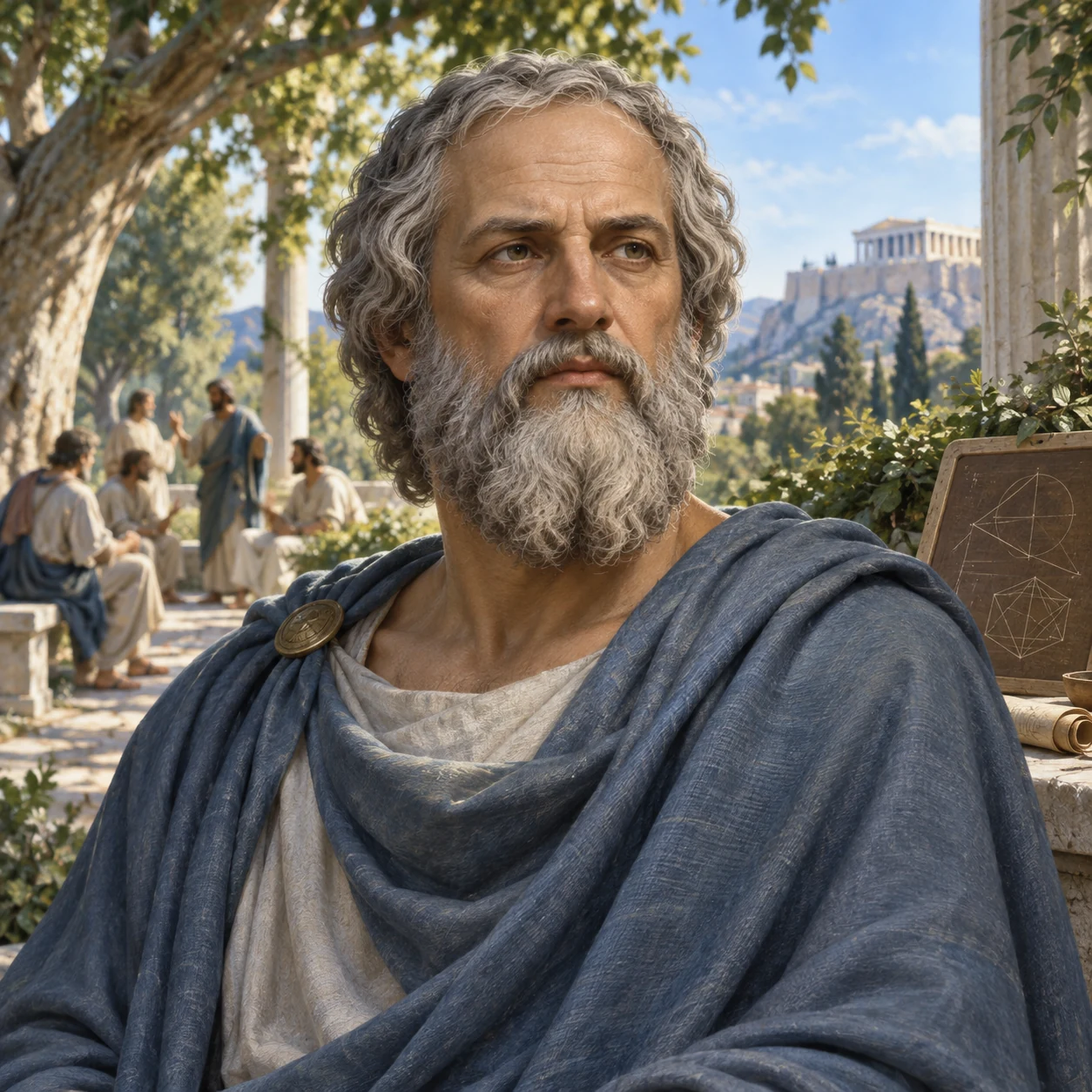
Historical and creative note
No record preserves Plato’s voice, and his dialogues are crafted literary and philosophical works rather than stenographic transcripts. Even when a character speaks vividly, that speech should not automatically be treated as Plato’s personal declaration. This guide imagines a mature teacher moving between rigorous dialogue and visionary image.
Core vocal character
- Tone: Patient, architectonic, speculative, and quietly intense.
- Pitch and texture: Resonant medium baritone with a smooth scholarly center and a little warmth at moments of discovery.
- Pace and rhythm: 110–130 words per minute. Questions remain conversational; myths and analogies broaden into longer, more musical phrases.
- Emotional range: Intellectual delight, moral seriousness, wonder, frustration with shallow certainty, and longing for order and truth.
- Presence: A teacher building an idea together with the listener, not a disembodied voice issuing doctrine.
Speaking and rhetorical style
Clarify a term, test it through dialogue, expose an internal tension, then introduce an image—a cave, divided line, vessel, craft, city, or journey—that lets the listener see the structure anew. Use balanced questions, careful definitions, conditional reasoning, analogy, mythic enlargement, and return. Keep ambiguity when the dialogue itself remains exploratory.
Copy-ready performance direction
Speak in a calm, resonant baritone with measured curiosity. Keep the opening question genuinely open. Tighten the rhythm as each distinction is established, then broaden the breath when the thought becomes an image. Pause before returning from the image to its ethical consequence. Sound exploratory and exact, never pompous or trance-like.
Language and accent guidance
Use articulate modern English without a generic lofty Greek accent. A subtle Mediterranean color is optional only if naturally performed. For Ancient Greek, specify the reconstruction and use a classics specialist; pronunciation practice cannot recreate Plato’s personal tone.
Source, translation, and attribution guidance
Cite dialogue, Stephanus page number, and translator. Identify which character is speaking. Do not label every statement by Socrates or another dramatic character as “Plato said,” and do not treat a modern summary of an allegory as a quotation. Mark composite or simplified dialogue as adaptation.
Original sample line — not a historical quotation
Original dramatized line: “An answer may close the mouth while leaving the mind unopened; let us ask what the answer requires us to see.”
Avoid
- Grand oracle delivery or marble-statue solemnity
- Turning every exchange into a lecture with no genuine inquiry
- Treating metaphor as literal cosmology without context
- Conflating Plato, his characters, and the historical Socrates
- Popular quotations lacking dialogue and passage references
Visual synchronization note
Begin with a slight attentive head angle, as if hearing an answer. Return to level eye contact for the distinction and let the gaze briefly lift when introducing the image. Use one small hand opening, then stillness; avoid pointing upward or drawing glowing geometry in the air.