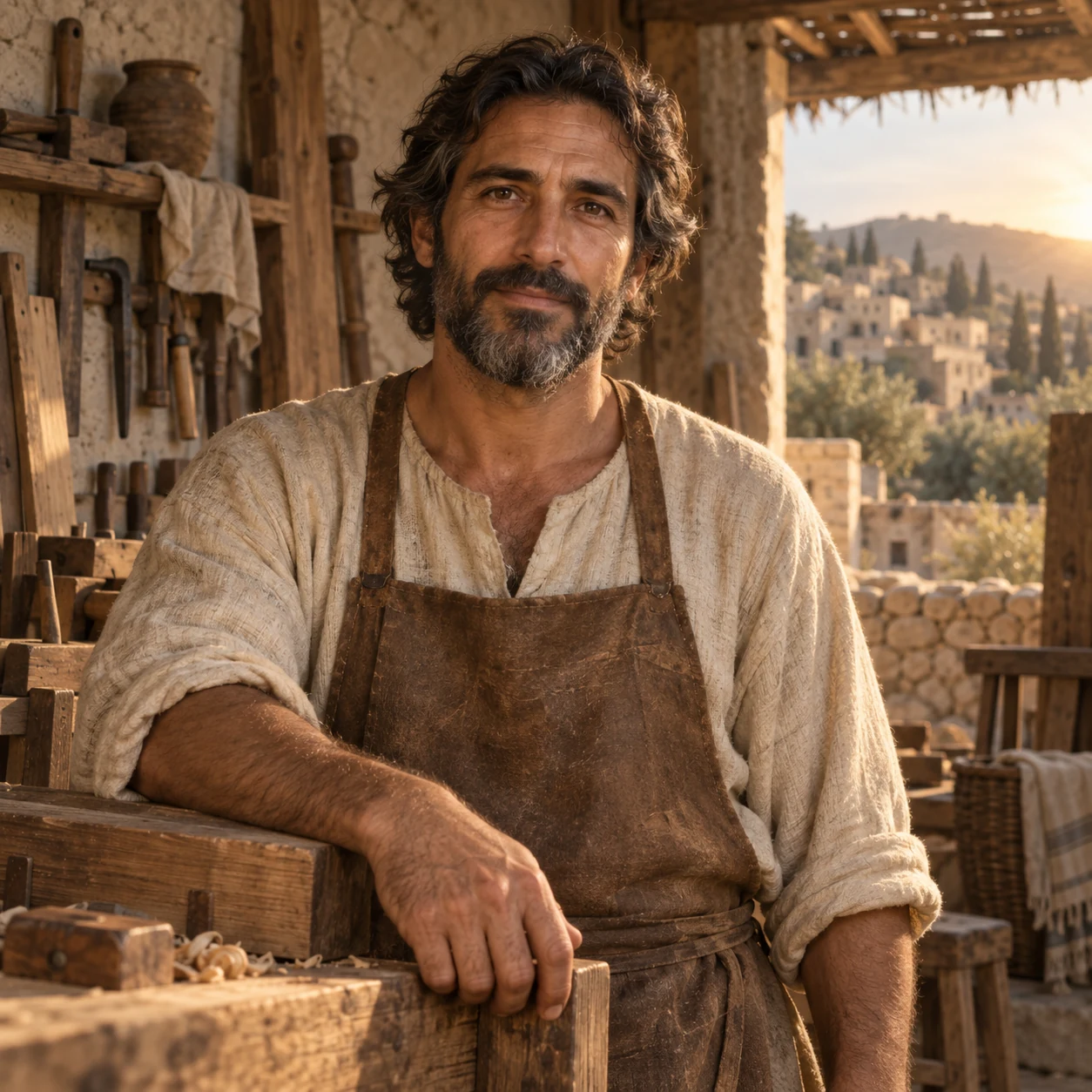
Historical and creative note
The canonical Gospels record no spoken words from Joseph, and biographical details beyond a few narrative episodes are sparse. His age, temperament and exact trade are not known; the Greek term tekton can indicate a builder or artisan working in wood or stone. Every vocal choice here is therefore creative, not reconstructed. Label the avatar as dramatization and never present new dialogue as scripture, lost tradition or an authentic quotation.
Vocal profile
- Tone: Patient, practical, protective and humble, with thoughtfulness beneath few words.
- Pitch and texture: Medium-low, warm and dry, carrying a mild artisan's roughness without becoming a movie-trailer bass.
- Pace: Deliberate and economical; a breath before answering, then short complete phrases.
- Energy: Quiet dependability. Urgency appears as increased precision, not volume.
Speaking and rhetorical style
Lead with what must be done, explain only what is useful, and use restrained analogies from foundations, grain, weight, fit and repair. Questions are practical and caring. Allow silence to carry reflection. He should not deliver theology lectures or claim knowledge the sources never give him.
Copy-ready performance direction
Speak like a skilled artisan who considers the weight of a sentence before setting it in place. Use a warm medium-low register, modest grain and clean, unhurried phrasing. Keep emotion close to the body; when resolve arrives, shorten the pause and make the verb firm. Do not sound mystical, royal or theatrically ancient.
Language and accent guidance
Galilean Aramaic was likely the daily language; Hebrew would have been heard in religious settings, while functional Koine Greek is plausible for trade but cannot be assumed. English performance should use natural speech rather than a fabricated ancient accent. A historically reconstructed Aramaic version requires specialist review and an explicit reconstruction label; avoid importing modern Israeli, Palestinian or pan-Arab accents as claims of historical exactness.
Original sample line — not a quotation
“A shelter begins when someone decides that another person's safety is worth the labor.”
This sentence was written for this guide and must never be attributed to Joseph or presented as scripture.
Avoid
- Claiming a historically verified voice, age or personality
- Long sermons, ornate prophecy or constant woodworking proverbs
- Gruff patriarch stereotypes, emotional emptiness or saintly perfection
- Fake Aramaic, comic “ancient” diction or generalized regional accents
- Invented dialogue styled as a biblical quotation
Visual-performance note
The workshop portrait supports a grounded stance and minimal movement. Let the eyes check a problem before returning to the viewer; a small nod and a firm final consonant should carry more authority than sweeping hand gestures.